If you have inherited a home in Carmel-by-the-Sea, you may be managing an estate from out of town. This guide is written for the executor, administrator, or successor trustee responsible for handling the sale, and the heirs or beneficiaries who will eventually receive its proceeds, whether you're a Carmel-by-the-Sea resident or manage the estate from out of town.
We will walk through the legal path a Carmel-by-the-Sea property typically follows, whether that is probate or trust administration, and the practical path of getting a home ready and sold. We will also cover what makes selling an inherited home in Carmel-by-the-Sea different from selling almost anywhere else in California. Many homes that pass through inheritance here have been in the same family for decades, sometimes since before the town had house numbers at all.
Nothing in this guide is legal or tax advice. Your estate attorney and CPA are the right professionals to confirm anything specific to your situation. Our goal is simply to help you understand the process well enough to ask good questions and move at a pace that feels manageable.
Is Your Carmel-by-the-Sea Home in Probate or a Living Trust?
The first question to answer is a simple one: did the person who owned the home have a living trust, or not?
If the property was held in a revocable living trust, the successor trustee named in that trust document can typically sell the home without court supervision. Trust administration still involves paperwork, notices to beneficiaries, and often a CPA, but it moves outside the probate court system entirely. Many California homeowners who worked with an estate planning attorney set up a trust for exactly this reason, to keep real property out of probate.
If there was no trust, or if the home was left outside the trust for some reason, the property generally goes through probate. The court appoints an executor (if there was a will naming one) or an administrator (if there was not), and that person becomes responsible for the estate, including the sale of any real property.
To find out which situation applies, start with the decedent's estate planning documents. A trust, if one exists, is usually titled something like "The [Name] Family Trust" or "The [Name] Revocable Living Trust." Check the county recorder's office for how title to the home is currently held, since a deed transferring property into a trust is a matter of public record. An estate attorney can confirm this quickly, and the California Courts' self-help guide to probate is a good neutral starting point if you want to read the basics yourself.
California also has a simplified process for smaller estates, generally available when the entire estate is valued under $750,000. In practice, this threshold rarely applies to homes in Carmel-by-the-Sea. Property values here, and across Monterey County generally, often exceed that figure on the real estate alone, which means full probate is the more common outcome for homes in this market, even modest ones.
The California Probate Process for a Carmel-by-the-Sea Home, Step by Step
If your Carmel-by-the-Sea property is going through probate, the process follows a fairly predictable sequence, even though the pace can vary.
Appraisal. The court appoints a probate referee to formally appraise the real property and other estate assets as of the date of death. This sets an official value for the estate and later becomes relevant to the tax basis heirs receive.
Petition for authority to sell. The executor or administrator typically requests authority to sell real property at the start of probate or once a sale is needed. Under California's Independent Administration of Estates Act, many executors gain broad authority to sell without court approval for every step.
Notice of Proposed Action versus court confirmation. With independent administration, the executor can often sell by sending beneficiaries a Notice of Proposed Action and waiting a short objection period, rather than appearing in court. If the will restricts this authority, or the estate is under full court supervision, the sale instead requires a confirmation hearing before a probate judge.
Overbidding at confirmation. When a sale requires court confirmation, California law allows other buyers to submit higher bids in the courtroom, in set increments above the accepted offer. This can feel unusual to a family unfamiliar with probate sales, but it is a normal part of supervised administration.
Realistic timeline. In Monterey County, a full probate case typically runs 9 to 18 months from filing to final closing of the estate. The property sale itself does not have to wait for the entire case to wrap up. Once the executor has authority to sell, whether by independent administration or court confirmation, the home can often go to market and close well before probate formally closes.
Who is typically involved. A probate attorney guides the executor through court filings and deadlines. A probate referee handles the formal appraisal, and the executor signs on behalf of the estate. A real estate agent familiar with probate sales in Carmel-by-the-Sea coordinates pricing, marketing, and the transaction, working alongside the attorney rather than in place of one.
Who Can Legally Sell an Inherited Carmel-by-the-Sea Home, and What Happens When Heirs Disagree
Only the person with legal authority, the appointed executor, administrator, or successor trustee, can sign a listing agreement or a sale contract for an inherited property. Individual heirs, even if they are named beneficiaries, cannot sell the home on their own unless they hold that formal role. Cornell Law School's general overview of probate is a useful plain-language reference if you want a quick refresher on these roles and terms.
This matters most when several people inherit a Carmel-by-the-Sea home together and do not fully agree on what to do with it. One heir may want to sell, another may want to keep the home, and a third may not have decided. A few realistic paths forward exist.
One heir can buy out the others, if they have the financing and everyone agrees on a fair value. The group can agree to sell and split proceeds as the will or trust directs. If heirs truly cannot agree, any co-owner can file a partition action, asking a court to order a sale. Partition actions work, but they cost time and legal fees, and families who have been through one tend to call it a last resort, not a first move.
A few habits make disagreement easier to work through. Naming a single point of contact, usually the executor or trustee, keeps communication from splintering. A neutral third-party valuation, from an appraiser or an agent with no stake in the outcome, gives everyone the same starting facts. Setting expectations early about timeline and likely proceeds helps prevent surprises later.
A local agent who has handled inherited and probate sales before can be a genuinely useful neutral voice in these conversations. Not because they make the decision, but because they can answer factual questions about the Carmel-by-the-Sea market calmly, without an emotional stake in whether the family sells or keeps the home.
In one sale we worked on, three adult siblings who had inherited their parents' cottage had not all been inside the house together in years. We arranged a single walk-through, built around simple, factual questions rather than decisions that had to be made on the spot. Seeing the same rooms and hearing the same information at the same time did more to ease the tension than any conversation on the phone had.
What Makes Selling an Inherited Home in Carmel-by-the-Sea, California Different
Selling any inherited home involves the same basic legal and financial steps almost anywhere in the state. Carmel-by-the-Sea adds a few local details that surprise out-of-area executors more than almost anything else in the process. None of them should cause alarm. Knowing about them ahead of time simply makes the process smoother.
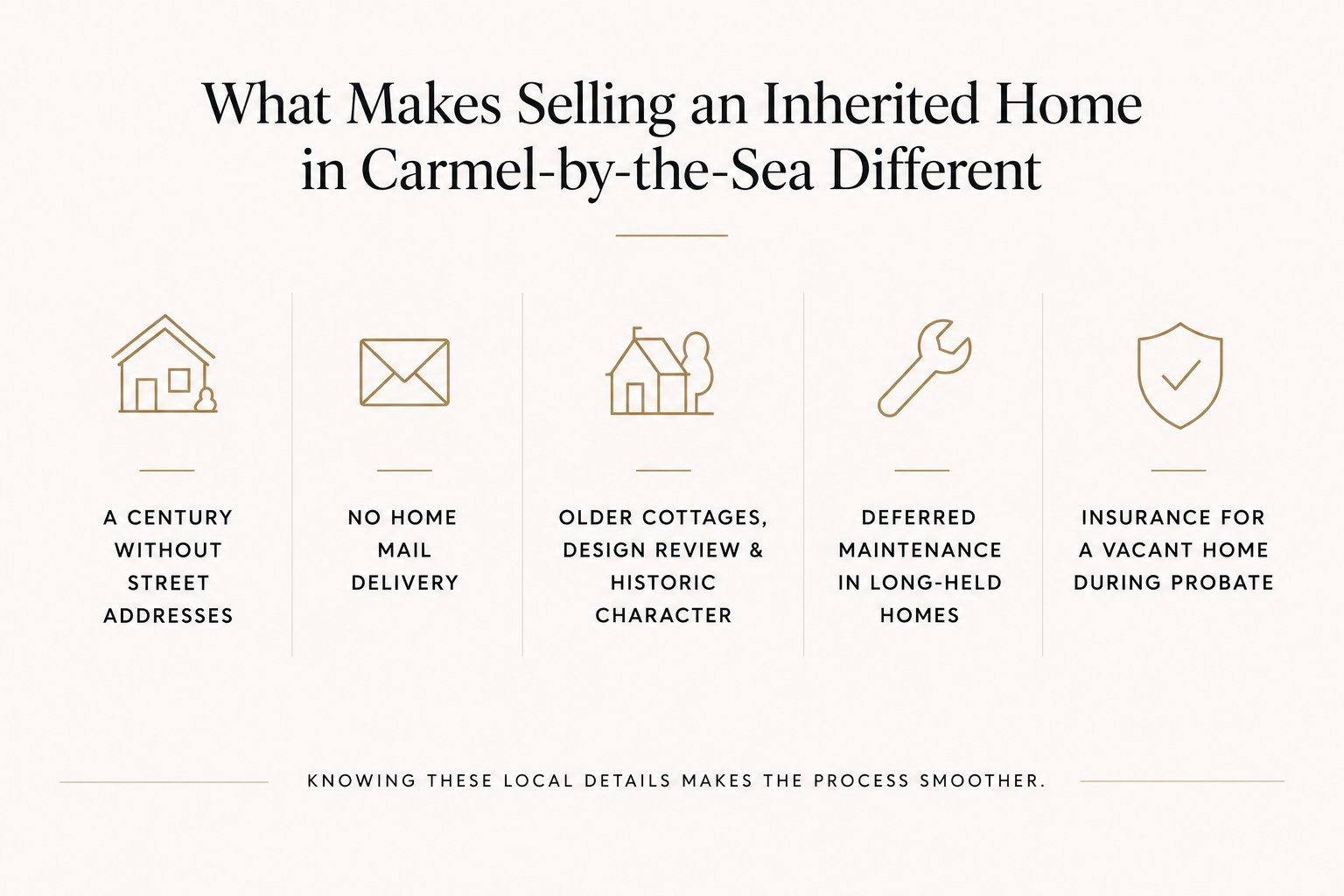
A Century Without Street Addresses in Carmel-by-the-Sea
For more than a hundred years, homes in Carmel-by-the-Sea were identified by lot and block descriptions, such as a specific lot on a specific block of a specific street, rather than by a house number. The city began rolling out true street addresses starting in 2024, and that rollout is still working its way through the community.
For an out-of-area executor, this can complicate a few tasks: confirming exactly which property a deed or tax bill refers to, pulling comparable sales, and setting up utility or insurance accounts correctly. A local agent who works with current Carmel-by-the-Sea listings and recent comparable sales can usually resolve this quickly, since matching a lot-and-block description to its location is routine here. As addressing continues to roll out, this friction is easing year by year.
No Home Mail Delivery in Carmel-by-the-Sea
Carmel-by-the-Sea has never had home mail delivery. Residents pick up mail at a P.O. box at the local post office instead. For a remote executor, this means court notices, insurance renewal letters, and property tax bills will not simply show up at the front door the way they might elsewhere.
If the decedent had a P.O. box, the executor generally needs to arrange access to it, forward mail to a current address, or open a new box in the estate's name. Handling this early helps, since missed notices during probate can cause delays that a short call to the post office easily avoids.
Older Cottages, Design Review, and Carmel-by-the-Sea's Historic Character
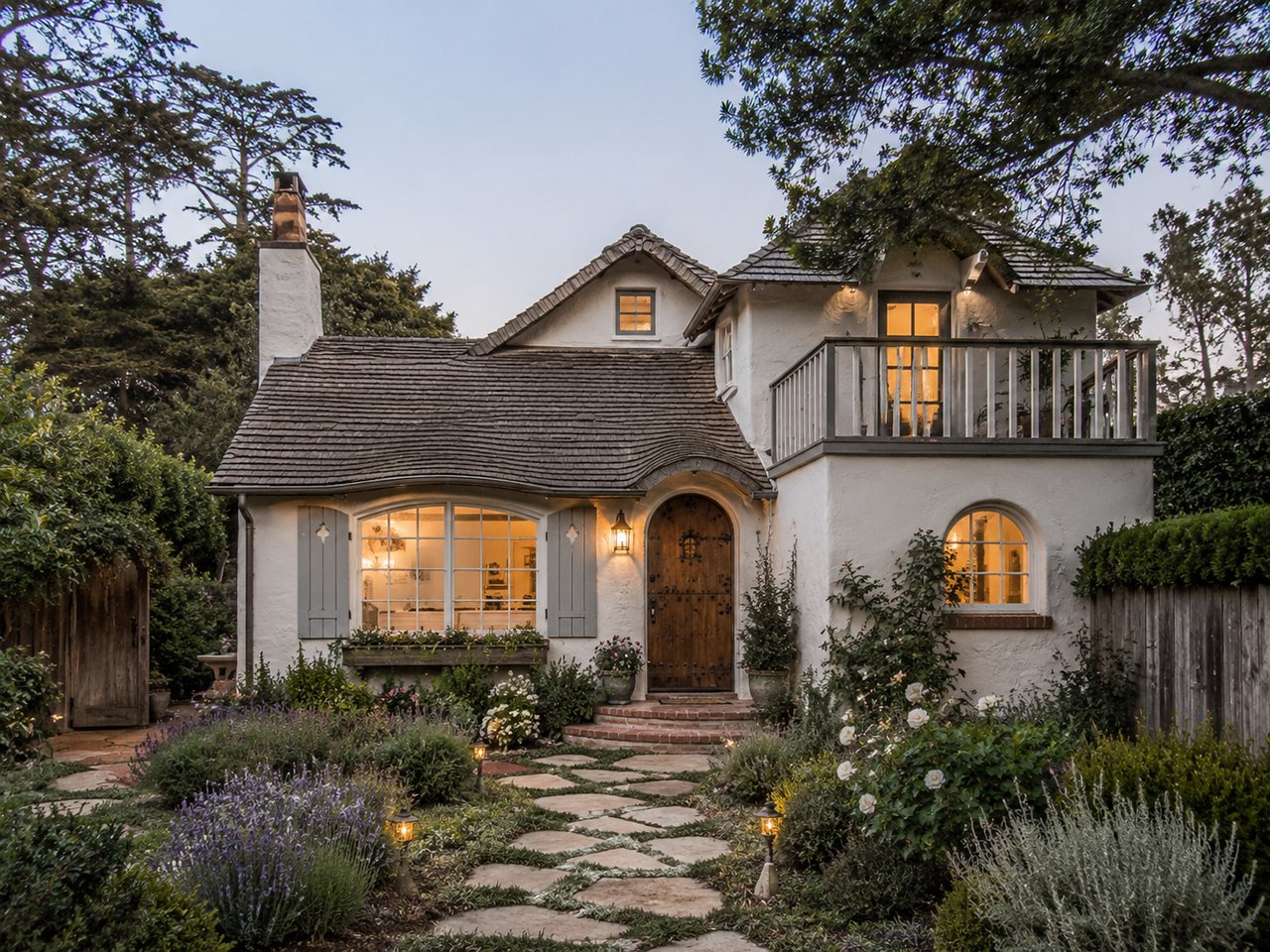
A large share of inherited homes in Carmel-by-the-Sea are older cottages, many built before 1950, in neighborhoods like Carmel Woods, Mission Fields, and the streets closer to the village. Our Carmel-by-the-Sea neighborhood guide covers how these pockets of town differ. That age is part of what gives the town its character, and it also means many of these homes fall under the city's Design Review Board process, and in some cases historic or demolition review, before any exterior changes can be made.
This matters most when a family is deciding between selling as-is or doing work first. Interior updates like paint, flooring, or fixtures typically do not trigger design review. Anything touching the exterior, from a new roofline to added square footage, likely will, so it is worth checking what the review process requires before committing to any renovation plan meant to lift sale value.
Deferred Maintenance in Long-Held Carmel-by-the-Sea Homes
Homes that have stayed in one family for thirty, forty, or fifty years often carry some deferred maintenance. Original wiring, older plumbing, and small nonconforming lot lines are common in a town built out gradually over more than a century. These things tend to surface at inspection, not before.
None of this is unusual, and none of it needs to derail a sale. A baseline inspection before listing gives the executor and heirs a clear picture of what a buyer's inspector is likely to find, so there are no surprises mid-transaction.
Insurance for a Vacant Home in Carmel-by-the-Sea During Probate
An inherited home often sits vacant for some or all of the probate period, and a vacant coastal or forested-lot property can be harder to insure through a standard carrier. Some homes end up on California's FAIR Plan, the state's insurer of last resort for higher wildfire or coastal risk areas, at least temporarily.
It is worth confirming coverage early, rather than assuming an existing policy will simply continue. A brief lapse on a vacant property is one of the more avoidable stresses in this process, and an early call to the estate's insurance agent usually prevents it.
Preparing an Inherited Home in Carmel-by-the-Sea for Sale
Once the legal authority to sell is in place, preparing the home itself usually comes next.
Securing the property is the first step: changing locks if needed, confirming utilities are on, and arranging regular checks if the executor lives elsewhere. Clearing personal belongings is often the hardest part emotionally, and there is no need to rush it. Sorting items into keep, donate, and sell piles, and giving family members a chance to claim keepsakes first, tends to go more smoothly with a little time built in.
A baseline inspection gives everyone a shared, factual picture of the home's condition. From there, most families choose one of two paths: selling as-is, often the right call for a home with real deferred maintenance, or making light, targeted updates first, when a modest investment is likely to meaningfully increase what the home sells for.
For heirs who want to prepare a home for sale without paying contractors out of pocket while probate is open, programs like Compass Concierge prep financing for a Carmel-by-the-Sea home let sellers make improvements with no upfront cost, repaid at closing. This can be a genuinely useful option for an estate with equity but limited cash on hand.
One caution worth repeating here: any exterior or structural work should be checked against Carmel-by-the-Sea's Design Review requirements before work begins, not after. A quick conversation with a local agent or the city's planning department upfront can save real time later.
Pricing and Marketing an Inherited Home in Carmel-by-the-Sea
Two different valuations matter for an inherited home, and it helps to keep them separate in your mind.
The date-of-death appraisal, ordered by the probate referee or an independent appraiser, establishes the home's value as of the date the owner passed away. This figure matters for tax purposes, since it generally becomes the heirs' stepped-up basis in the property, covered in the next section. It is a tax and legal figure, not a marketing one.
Current market valuation is a separate question: what will this home sell for today, given buyer demand and recent comparable sales. A local agent sets this price using recent closings in Carmel-by-the-Sea and comparable neighborhoods, current inventory levels, and the home's specific condition.
Carmel-by-the-Sea is a small, low-inventory market with consistently high demand, which shapes how a home is marketed. Pricing an inherited or probate-flagged property here calls for the same careful comparable analysis as any other home sale in Carmel-by-the-Sea, along with clear disclosure of the probate status to buyers and their agents, so expectations are set from the first showing.
There is also an emotional layer worth naming plainly. Pricing a family home, and having strangers walk through rooms that hold decades of memory, is genuinely hard, even when everyone agrees selling is right. A good agent handles showings and buyer conversations with this in mind, without letting sentiment override sound pricing strategy.
Taxes and Financial Considerations for Carmel-by-the-Sea Heirs
Tax questions are usually the ones that worry heirs most, and the good news is that inherited property receives favorable treatment under federal tax law.
Stepped-up basis, explained simply. When you inherit a home, your tax basis in that property generally resets to its fair market value on the date the previous owner died, rather than what they originally paid for it decades earlier. Say a home was purchased in 1975 for $60,000 and was worth $2.4 million on the date of death. Heirs who sell shortly after for close to that $2.4 million figure typically owe little or no capital gains tax, because their basis is the date-of-death value, not the original purchase price. This is why most heirs who sell an inherited home reasonably promptly, near its date-of-death value, pay far less in capital gains tax than the original owner would have. The IRS covers this in detail in Publication 559 for survivors, executors, and administrators.
California Proposition 19 and reassessment. Under Proposition 19, an inherited home not used as the inheriting child's primary residence is generally reassessed to current market value for property tax purposes, which can raise the annual bill compared with what the previous owner paid. There are exceptions and filing requirements, so this is a good question for the estate's CPA or attorney, or the California State Board of Equalization's Proposition 19 resources.
Transfer tax and closing costs. Selling an inherited home in Carmel-by-the-Sea involves the same categories of closing costs as any other California sale: county and any applicable city transfer taxes, title and escrow fees, and standard closing costs. Exact figures depend on the sale price and terms, so we recommend confirming precise numbers with the estate's CPA or attorney rather than relying on general estimates.
Distributing proceeds. Once a sale closes, proceeds are typically distributed among beneficiaries according to the terms of the will or trust, after the estate's debts, taxes, and administration costs are paid. The executor or trustee oversees this distribution, usually working with the estate attorney to make sure it is documented correctly.
We are not tax advisors, and none of the above should be taken as specific tax guidance for your estate. Please confirm any figures or strategies with your CPA or estate attorney before making decisions based on them.
Timing the Sale in Carmel-by-the-Sea's Seasonal Market
Carmel-by-the-Sea has a real seasonal rhythm. Spring and summer typically bring the most buyer activity, as visitors and prospective residents experience the town at its best. August brings Car Week, when the Peninsula fills with collectors and enthusiasts, and local attention shifts toward events for a stretch of the month.
For a family managing probate, it helps to hold these seasonal patterns loosely against the court's actual deadlines, rather than treating them as a race. Probate timelines are set by the court process, not the calendar year, and there is usually more flexibility than people expect about when to list. A well-timed listing, even one that waits a season for better buyer activity, often outperforms one rushed onto the market at an off moment.
Reviewing current Carmel-by-the-Sea market reports before setting a listing date can help the executor and heirs understand buyer demand right now, and whether waiting a few weeks or months makes a real difference. In most cases, timing the sale thoughtfully does not conflict with moving the estate forward. Probate underway is not a reason to rush a decision that deserves a clear head.
How the Bambace Peterson Team Helps Executors and Heirs in Carmel-by-the-Sea
Dana Bambace and Mark Peterson have worked directly with executors, trustees, and families selling inherited homes across Carmel-by-the-Sea and the wider Monterey Peninsula. Whether a probate sale or an ordinary transaction, it's important that who you chose to represent your property understands the market and has a proven record of delivering results. One recent example is detailed in our case study on earning more than $1.1 million for beneficiaries selling a Carmel-by-the-Sea estate, which walks through how careful pricing and preparation translated into real value for the beneficiaries.
We are not sharing that story to suggest every sale reaches the same number. Every estate and every home is different. We share it because it reflects the work we do regularly: helping families understand a process that can feel unfamiliar, coordinating closely with the estate's attorney and CPA, and handling local logistics, from Design Review questions to comparable sales research, specific to this market.
If you would like to know more about our background working with estates and inherited properties in Carmel-by-the-Sea, our About page covers our approach in more detail. Our goal in every conversation with an executor or heir is the same: make the process clear, keep the pace manageable, and let you decide with full information rather than pressure.
Frequently Asked Questions About Selling an Inherited Home in Carmel-by-the-Sea
How do I sell a house I inherited in Carmel-by-the-Sea, California?
Start by confirming whether the home is held in a trust or subject to probate, since that determines who has legal authority to sign a sale. Once that authority is established, a local agent, familiar with pockets of town like Carmel Woods and the streets closer to the village, can help you get the property appraised, prepared, and listed, working alongside your estate attorney throughout.
Do all heirs have to agree to sell an inherited house in Carmel-by-the-Sea?
Not legally. Only the appointed executor, administrator, or successor trustee can sign the sale documents for a Carmel-by-the-Sea property, though most families still aim for agreement among all heirs before moving forward. When heirs genuinely cannot agree, options include a buyout, a straightforward sale with split proceeds, or, rarely, a court-ordered partition action.
How long does it take to sell a house in probate in Carmel-by-the-Sea?
A full probate case for a Carmel-by-the-Sea home typically takes 9 to 18 months from filing to close of the estate, based on typical Monterey County timelines. The property itself can often be listed and sold well before probate fully closes, once the executor has authority to sell.
Do I have to pay capital gains tax on an inherited house in Carmel-by-the-Sea?
Often little or none, thanks to the stepped-up basis rule, which generally resets your tax basis to the home's value on the date of death rather than what the original owner paid. Selling a Carmel-by-the-Sea home reasonably close to that date-of-death value, whether a Mission Fields bungalow or a home nearer the coast, typically results in a modest taxable gain, if any. Your CPA can confirm the specifics for your estate.
What is the $750,000 probate threshold in California, and does it apply to Carmel-by-the-Sea homes?
California allows a simplified small-estate process for estates valued under $750,000. Because home values in Carmel-by-the-Sea and across Monterey County typically exceed that figure, most Carmel-by-the-Sea estates that include real property go through full probate rather than the simplified process.
Can I sell an inherited Carmel-by-the-Sea house before probate is finished?
Yes, in most cases. Once the executor has court authority to sell, whether through independent administration or a confirmed sale, a Carmel-by-the-Sea home can be listed and closed while the rest of the probate case is still open.
What happens if my siblings and I disagree about selling our family home in Carmel-by-the-Sea?
Disagreement among heirs over a Carmel-by-the-Sea home is common, and there are a few practical paths forward. A buyout, a straightforward sale with proceeds split among heirs, or in rare cases a partition action are the usual options, and a neutral third-party valuation often helps everyone start from the same facts. Naming one point of contact, whether that is Carmel Point or the Golden Rectangle where the home sits, tends to keep communication simpler.
Does Carmel-by-the-Sea have street addresses now, and does that affect selling an inherited property?
Carmel-by-the-Sea began adding true street addresses starting in 2024, after more than a century of lot-and-block property descriptions. For an inherited Carmel-by-the-Sea property, this history can briefly complicate matching records, comps, and insurance accounts to the right home, though a local agent familiar with the change can usually sort this out quickly.
What is a stepped-up basis and how does it affect selling an inherited home in Carmel-by-the-Sea?
Stepped-up basis means your tax basis in an inherited Carmel-by-the-Sea home generally resets to its value on the date the previous owner died, rather than their original purchase price decades earlier. This is why heirs who sell a long-held Carmel-by-the-Sea property reasonably promptly often owe little capital gains tax, since most of the appreciation before the date of death is not taxed to them.
Do I need a probate attorney to sell an inherited house in Carmel-by-the-Sea?
While it is technically possible to handle some probate steps without one, most executors selling a Carmel-by-the-Sea home work with a probate attorney to manage court filings, deadlines, and notices correctly. A local real estate agent typically works alongside that attorney, handling the pricing, marketing, and logistics of the sale itself.
If you are an executor, trustee, or heir sorting out what comes next for a Carmel-by-the-Sea property, we would be glad to talk it through with you. There is no pressure and no obligation, just a conversation about your specific home, your timeline, and what a sale might realistically look like. We regularly work alongside estate attorneys and CPAs, so you do not have to explain the probate side twice. When you are ready, you can contact the Bambace Peterson Team about your Carmel-by-the-Sea property for a confidential conversation.